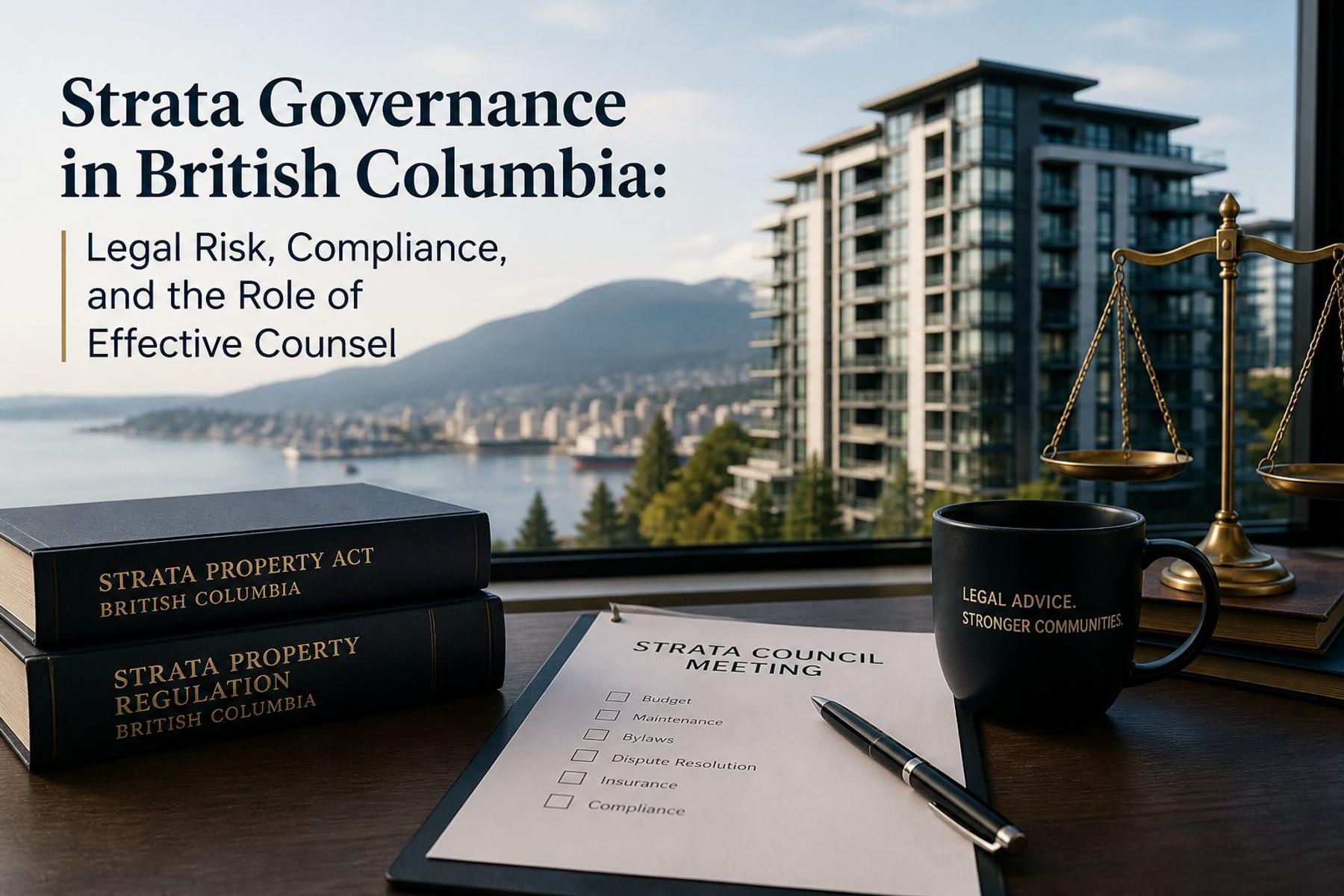
Strata Governance in British Columbia: Legal Risk, Compliance, and the Role of Effective Counsel
This blog outlines some common legal risks facing strata corporations in British Columbia.

Strata corporations in British Columbia operate within one of the most detailed and fast-evolving governance frameworks in Canada. Under the BC Strata Property Act (SPA), strata councils and property managers carry significant legal responsibilities that extend well beyond day-to-day building operations. As buildings age, costs rise, and owner expectations increase, strata governance has become more complex and more legally exposed.
This blog outlines some common legal risks facing strata corporations in British Columbia.
1. By-law Enforcement and Procedural Fairness
By-law enforcement is a key duty of strata councils, but it must follow strict procedural steps. Before issuing fines or taking action, the strata must provide written notice of the complaint, include sufficient particulars, and give the owner or tenant an opportunity to respond or request a hearing. If these requirements are not followed, enforcement may be invalid, as confirmed in Terry v. The Owners, Strata Plan NW 309. For strata managers, consistent compliance with this process is essential.
Councils must also enforce bylaws fairly, reasonably, and in good faith. While there is some discretion, inconsistent or heavy-handed enforcement can lead to legal challenges, while failing to enforce may result in claims of unfairness. As noted in Abdoh v. Strata Plan KAS 2003, enforcement must be balanced with prudence. Tools such as fines, remediation, and tribunal or court action are available, but should be used carefully and consistently.
2. Strata Management & Records Keeping
The relationship between a strata corporation and its manager is fundamentally contractual, grounded in the authority set out in the Strata Property Act. Councils have broad discretion to select and instruct management, as confirmed in Enefer v Strata Plan LMS 1564, 2005 BCSC.
From an operational standpoint, managers act as agents of the corporation, exercising delegated authority while remaining accountable to the council. This agency relationship carries fiduciary duties, including acting honestly, disclosing conflicts or benefits, and applying reasonable care and skill in all services. The importance of process and documentation is highlighted in Hamilton v The Owners, Strata Plan NWS 1018, 2017, BCCRT 141, where correspondence handled by the manager was found to form part of the corporation’s official records, unlike informal council communications. In practice, this means decisions, instructions, and communications should always be channeled and recorded properly, as they may later define the corporation’s legal position.
3. Financial Planning and Special Levies
Strata corporation finances are ultimately about discipline: how money is collected, approved, and spent within the framework of the SPA. The operating fund does the heavy lifting, covering recurring expenses through strata fees set by an approved budget, with contributions typically calculated by unit entitlement.
Where things tend to get more complex (and more contentious) is around special levies, deficits, and allocation. Special levies must be approved (typically by a ¾ vote) and can only be used for the specific purpose they were raised for, which becomes critical when projects evolve or costs shift. Cases like Strata Plan LMS 1537 v Alvarez, 2003, BCSC 1085confirm the default principle that all owners must contribute to the costs of repair and maintenance in accordance with unit entitlement. Further, financial planning is shaped by mandatory long-term forecasting tools such as depreciation reports, which identify expected repair and replacement costs over a 30-year horizon and guide contributions to the contingency reserve fund. These tools shift strata finance from reactive spending to forward-looking capital planning
The Importance of Seeking Legal Advice
Given the complexity of the SPA and the procedural requirements governing strata operations, legal advice plays an important preventative role in risk management. Many strata decisions whether related to bylaw enforcement, expenditures, or governance, carry legal consequences, and even minor procedural errors can invalidate decisions or expose the strata to liability.
Legal guidance is particularly valuable in enforcement disputes, financial decision-making, and interpreting statutory obligations. Courts and tribunals consistently emphasize procedural fairness and strict compliance, meaning that early advice often helps ensure decisions are defensible, consistent, and compliant with the SPA.
This blog post provides general information and is not intended as legal advice. Laws change frequently, please contact DuMoulin Boskovich LLP for advice specific to your situation.
Related Service